

Production
What Information Should You Give Your Manufacturer Before Contract Manufacturing Starts?
A practical brief checklist of product, fabric, quantity, sample, lead time, quality and shipment details to give a manufacturer before contract manufacturing.
- Published:
- Last updated:
- Reading time
- 8 min read
Contents
In contract manufacturing, a significant share of problems begins not on the production line but in the first meeting. A short description such as "navy, wool, suiting" is not enough to convey the product the buyer has in mind. The manufacturer then has to fill in the missing information with its own assumptions. The result is often repeated samples, recalculated prices and slipping delivery dates.
This guide brings together, in a single structure, the information that should be prepared before a fabric or contract manufacturing request is passed on to the manufacturer. The aim is to ensure that purchasing and collection teams go into the first meeting with a complete technical brief.
Short Answer
Before contract manufacturing starts, the following should be communicated to the manufacturer in writing: a definition of the product and the collection, the end use, fabric expectations and composition, colour and pattern information, the order quantity, the sample status, the target delivery date, quality and tolerance expectations, packing and shipment terms, the approval process and the contact persons responsible for each area. The clearer this information is, the more realistic the manufacturer's assessment of feasibility, price and lead time will be. Every item left incomplete comes back at later stages of the process as extra cost and lost time.
Summary
- The technical brief is the basis for the manufacturer's price and lead-time calculations. That is why it should be written, not verbal.
- The product definition and end use should be settled before the fabric expectations.
- Colour, pattern and quality expectations should always be backed up by a physical reference.
- Tolerances and acceptance criteria should be defined jointly by both parties before production starts.
- If the approval steps and contact persons are clear from the start, the process does not stall.
- The checklist below can be used as a final check before sending the brief.
Product, Collection and End Use
The first part of the brief should answer the manufacturer's question: "What is this fabric being produced for?" State the product group (such as suits, jackets, trousers or dresses), the target season and the positioning of the collection. Is the fabric needed for a repeat product, or for a one-season collection project? This distinction directly affects the manufacturer's planning and yarn procurement.
The end use determines the performance expected from the fabric. A product for intensive everyday wear has different priorities from one that is worn only on certain occasions. Stating the climate of the target market, the environment in which the product will mainly be used and any care expectations (e.g. easy care, dry cleaning) makes it easier for the manufacturer to propose the right construction.
Fabric Expectations and Composition
Fabric expectations cover information such as the desired appearance, handle (how the fabric feels to the touch), drape, weight range and fabric width. If possible, share a fabric swatch you like as a reference, and state clearly which of its characteristics should be kept and which should change.
For composition, specify the target fibre percentages and state whether they are fixed or flexible. For example, if a certain wool percentage is required for a marketing claim, that is a constraint. If you are open to alternative blends because of a cost target, that is a preference. Distinguishing between the two in the brief avoids unnecessary rounds of quotations. For the effect of fibre choice on product behaviour, see the fabric composition guide.
Colour, Pattern and Sample
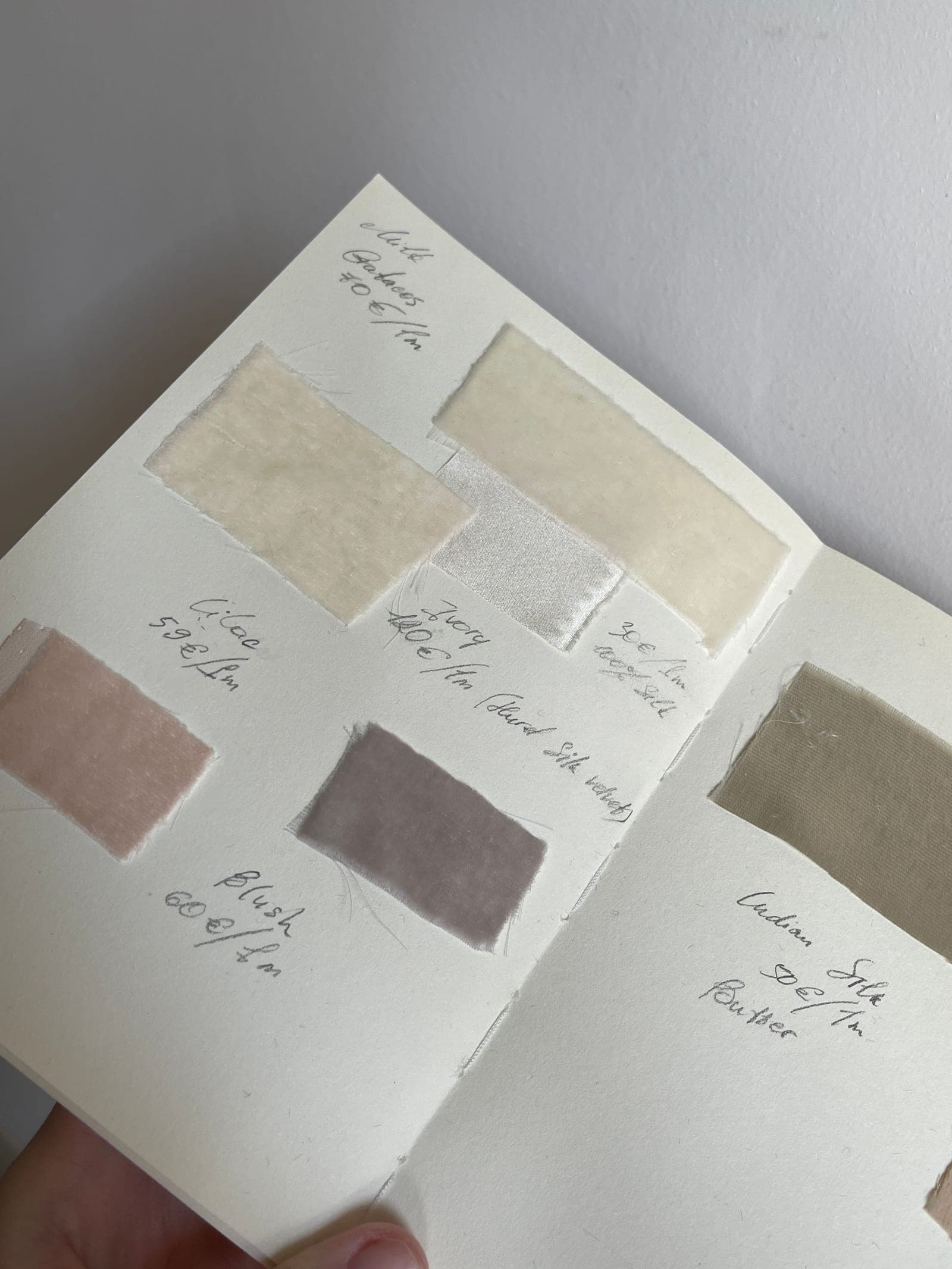
Colour information should be provided with a physical reference, not a screenshot. This reference can be a fabric swatch, a yarn or the colour card your company uses. Because screens and prints display colour differently, digital images should only be used as supporting information. For patterned products, specify the pattern size (repeat), the number of colours and the variants.
Also state the sample status clearly. Do you have an approved sample on hand? Are you expecting a new sample or lab work from the manufacturer? We cover in detail which information needs to be recorded when moving from the sample stage to bulk production in our sample to bulk production checklist.
Quantity and Target Delivery Date
Give the quantity as a total in metres, broken down by colour/pattern. Also state whether you are planning a single delivery or split deliveries, and whether there is a chance of repeat orders during the season. Minimum order quantities and production times vary from manufacturer to manufacturer and depend on the product construction and the time of year, so ask about them instead of assuming.
For the delivery date, instead of "as soon as possible", give the date you actually need: the date the fabric has to go into garment production and the collection calendar behind it. If the delivery date is flexible, saying so gives the manufacturer more room for sound planning.
Quality and Tolerance Expectations
When quality expectations remain abstract, disagreements are inevitable. Define which characteristics will be checked (such as colour, weight, width, surface defects and handle) and what counts as an acceptable deviation, either numerically or against a reference sample. The tolerance indicates how much deviation from the target value will be accepted. This range varies according to the product type and the company's quality procedure, so it should be discussed with the manufacturer and put in writing.
If your company applies specific tests, laboratory reports or inspection methods, add them to the brief. Which tests will be carried out, by whom and at what stage should be clear from the outset.
Packing, Shipment, Approval Process and Contact Persons
The packing section should cover roll length, rolling method, labelling and the information each roll must carry (product code, colour, lot, length in metres). For shipment, state the delivery address, the delivery terms, whether partial shipments are accepted and the information required on the shipping documents.
The approval process covers steps such as sample approval, approval of the first production run (pre-production) and pre-shipment inspection. State who will give approval at each step, through which channel and within what timeframe. Finally, share separate contact persons for purchasing, quality and technical matters, along with their contact details. Having a clearly identified decision-maker prevents production from coming to a halt while waiting for approval.
Brief Checklist
Before sending the brief to the manufacturer, check the items below one by one. Every business can add further items to this list in line with its own procedures.
Product and End Use
- Product group and style type stated
- Collection name and target season specified
- Stated whether the product is a repeat item or a one-season item
- Target market and usage environment defined
- Care expectations (washing, dry cleaning, easy care) stated
Fabric and Composition
- Desired appearance, handle and drape described
- Target weight range and fabric width specified
- Target composition stated, including whether the percentages are fixed or flexible
- Reference fabric swatch attached if available, with the characteristics to be kept noted
Colour, Pattern and Sample
- Physical colour references (fabric, yarn or colour card) provided
- Pattern size, number of colours and variants specified
- Stated whether an approved sample exists or a new sample is requested
- Expected sample size and quantity specified
Quantity and Delivery Date
- Total metres and breakdown by colour/pattern provided
- Split deliveries or possible repeat orders indicated
- Actual required date and collection calendar shared
- Stated whether the delivery date is flexible
Quality and Tolerances
- Characteristics to be checked listed
- Acceptable deviations defined numerically or against a reference sample
- Any required tests, reports and inspection methods added
- Procedure to follow in case of defects discussed
Packing and Shipment
- Roll length, rolling and label details specified
- Delivery address and delivery terms stated
- Stated whether partial shipments are accepted
- Information required on the shipping documents listed
Approval and Contact Persons
- Approval steps for the sample, pre-production run and pre-shipment defined
- Approver and approval channel set for each step
- Purchasing, quality and technical contact persons listed with their contact details
Before You Share the Brief
You do not have to fill in every item in the brief. Some topics, such as composition or weight, can be clarified together with the manufacturer. What matters is to indicate which information is fixed and which is still open. Saying "We look forward to your recommendation on this" is also valid and valuable information.
For a general idea of the contract manufacturing model and fabric groups, take a look at the Production and Fabrics pages. You can send the brief you have prepared directly via the Request a Quote page. The Arkadaş Tekstil team will contact you about any items that are missing or need clarification.
Frequently Asked Questions
Do I have to provide all the information in the brief from the start?
It is not mandatory, but every missing item makes the price and lead-time assessment less certain. Where something is still undecided, saying so clearly and asking for the manufacturer's recommendation is better than writing nothing at all.
Is a screenshot enough for colour information?
Usually not. Screens and prints can display colour differently. Providing a physical reference such as a fabric swatch, yarn or colour card reduces the disagreements that can arise during colour approval.
Who sets the tolerance values?
Tolerance values should be set jointly by the buyer and the manufacturer. The buyer's quality procedure is the starting point, while the manufacturer assesses realistic ranges based on the fabric construction. The agreed values should be recorded in writing.
What should be checked in bulk production after sample approval?
Bulk production should be checked for consistency with the approved sample in terms of colour, weight, width, handle and surface appearance. You can find these steps as a detailed list in our guide on moving from sample to bulk production.
Related Guides
Collection & Sourcing
From Fabric Sample to Bulk Production – A Checklist for Buying Teams
The colour, fabric weight, width, hand, approval record and lead time checks buying teams need when approving a fabric sample and moving to bulk production.
8 min read
Collection & Sourcing
How to Choose Fabric Composition
How to choose fabric composition, covering how wool, polyester and blends behave, care expectations, the cost/performance balance and sample evaluation.
9 min read
Fabric Knowledge
What Is Fancy Fabric? Where Is It Used?
Fancy fabrics are collection fabrics set apart from standard constructions by yarn, texture, pattern and surface effects. Uses, sampling and briefing.
8 min read